The Someday Funnies
edited by Michel Choquette
Abrams, 2011
This great big beautiful $110 book began in 1971 as a proposed 24-page colour spread in Rolling Stone, featuring the work of not only famous cartoonists, but authors and musicians from America and Europe, mainstream and underground, all commenting on the decade Rolling Stone has never left: the 1960s. Six years later the project had mushroomed beyond all economic sense and it was reluctantly shelved. By 2009, The Someday Funnies had achieved legendary status as a lost comic book, truly something from the shelves of Hicksville, and after a major article by Bob Levin in the Village Voice, the pages were finally disinterred from storage and turned into the huge coffee table book currently cutting off the circulation to my legs.
Some of the 129 comics are magnificent. Many are average. Most are very much of their own time: while putting the ’60s into perspective they become bogged down with their own ’70s baggage, which isn’t a pleasant reading experience from the ’10s. Some contributors (especially the writers who can draw) dazzle: witness Tom Wolfe’s advice to “Don’t do what you see me doing… wait two or three years”. There’s lost pages from Vaughn Bode, Goscinny & Uderzo and Will Eisner. There’s about four accounts of the Kennedy assassination, and no-one can draw the Beatles properly. So much for the actual content.
What’s the problem? Well, don’t get me wrong, I have nothing personally against the Boomers, but they’ve certainly proved themselves incapable of preserving their own legacy. From boxsets which cost more than the original “classic” album did to record, to easy-comfort jeans with extra room for their great big arses, everything the Boomers revisit turns to shit.
First the bloat: 121 pages of strips have been pumped up to a 216 page book. The rest is filled with essays about the ’60s, a brief history of Western comics, a preface, biographies of the 169 contributors (a third of whom are deceased, it’s cheerfully noted) and even biographies of the contemporary team who assembled the project. And an essay by Bob Levin about Choquette. And an index. And another index. Holy fuck, and an “abridged version”, which reprints the increasingly terse Do-Not-Want notes from Choquette’s potential publishers.
Then there’s the treatment of the material. The strips have been digitally coloured according to their original colour guides, but this has resulted in some very dark backgrounds and obscured some fine detail. The many foreign strips are printed in their original language to preserve some sort of integrity. The translations are waaaay at the back, and these pages aren’t exactly easy to flick back and forth. Worst of all, blank space was left on many of the pages to provide room for Robert Crumb to fill in with a sardonic commentary by Mr. Natural. Apparently he was never consulted about this, so instead the space has been filled by cute little contemporary drawings by Michael Fog of the adventures of the long-haired editor as he toddles around the world collecting pages.
Oh, but they’re whimsical! He gets mistaken for a girl in an English pub, steps in dog crap in Paris and wrestles with unwieldy portfolios in China! Meanwhile on the same pages Kennedy looses his head, Vietnam gets bombed and many, many people screw, drop acid and lose their trust in authority. So, only one problem with this fanciful “tongue-in-cheek-account” – no-one, not even the other characters on the page, fucking cares!
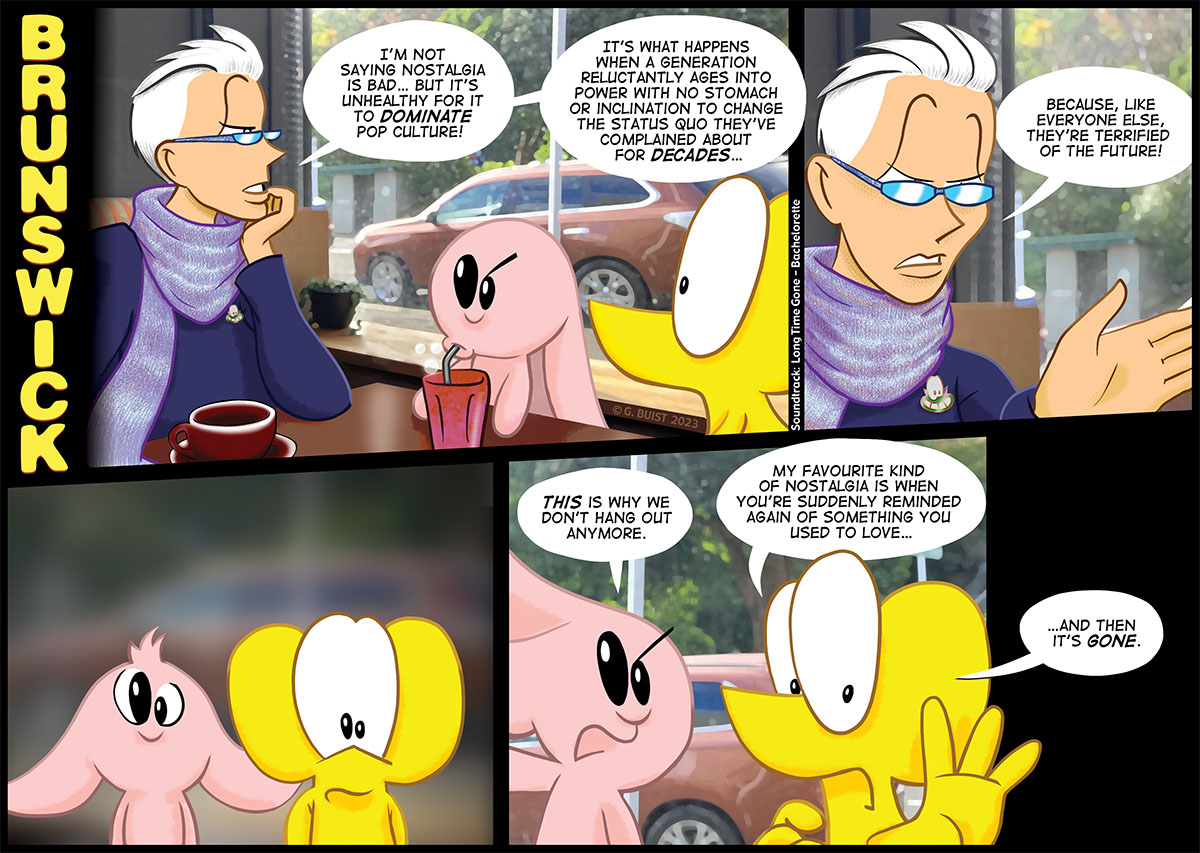


 The Name Of This Cartoon Is Brunswick
You must be logged in to post a comment.